Operators ask this question in two contexts. Sometimes they are planning a new deployment and wondering how much floor prep work is required. More often they are already running a robot on taped or magnetic strip paths and are asking whether they can change those paths without scheduling a repaint or retape job.
The short answer is: no tape or magnetic strips are required with a proximity-aware robot that navigates by SLAM (simultaneous localization and mapping). The longer answer involves understanding what floor-based guidance is actually doing, where software zone configuration has tradeoffs that tape does not, and where the hybrid approach makes more practical sense than either extreme.
What floor tape and magnetic strips actually do
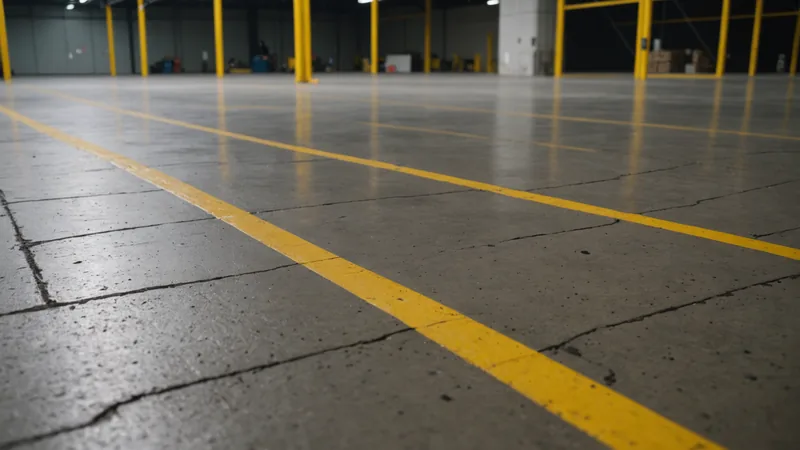
Floor tape and magnetic strips are physical path guidance systems. The robot follows the tape or detects the embedded magnetic field and steers to stay on the defined path. This approach has real advantages: it is predictable, it is easy for workers to visualize where the robot will travel, and it has zero dependency on software configuration being correct. If the tape is down and intact, the robot follows it. No map update required.
The cost side is well understood in facilities that have tried it. Tape wears and peels, particularly in high-traffic areas or where pallet jacks cross robot paths. Magnetic strips are more durable but more expensive to install and still require physical access to the floor when route changes are needed. Both approaches define fixed paths, which means route reconfiguration requires physical work and incurs downtime.
More significantly for mixed-traffic retail and logistics environments, fixed-path systems define where the robot goes but do not account for dynamic changes in what is on or near that path. A tape-following robot does not reroute around a misplaced pallet; it stops and waits. In a busy fulfillment environment with frequent floor-level changes, a stopped robot waiting for the path to clear can become a consistent throughput bottleneck.
What software zones do and what they require
Software zone configuration in a SLAM-navigating robot is a digital overlay on the robot's map. You define areas as "slow zones," "no-go zones," "merge-and-yield zones," or "free-traverse zones" through the fleet management interface. The robot respects these zone configurations without any physical marking on the floor.
Route changes, speed adjustments in specific aisles, and the addition or removal of zones all happen through software. A facility that reconfigures its picking layout quarterly can update robot routing in the same planning session as the floor plan redesign, without waiting for a tape crew or incurring floor downtime.
The tradeoffs are real. Software zones require that the robot's map remains accurate. If physical shelving is moved but the map is not updated, the robot's zone configuration references geometry that no longer exists. This creates either navigation errors or the robot operating outside its intended zone bounds because the physical reality has drifted from the map. Map maintenance is an ongoing operational requirement with software zones in a way it is not with physical tape.
Software zones also require that staff understand the configuration is invisible. Workers cannot look at the floor and see where the robot is allowed to go. This is not inherently unsafe, the robot's proximity sensing handles actual collision avoidance regardless of zone configuration, but it can create confusion in facilities where staff are accustomed to visible floor markings as guidance cues for their own navigation.
Where the reconfiguration question really lives
When operators ask "do I need to repaint the floor when I reconfigure aisles," they are usually asking about a specific pain point: their current process for changing a fenced AGV route requires a floor works team, scheduling downtime, and sometimes waiting for adhesive to cure. It is a project, not a configuration task.
With software-defined zones, aisle reconfiguration for the robot is a configuration task. Adding a new aisle to the robot's routing, changing speed limits in a specific zone, or redirecting the robot away from a section under maintenance are all software changes that take minutes to implement and take effect on the next task dispatch cycle. The physical aisle still needs to be reconfigured, but the robot's operating parameters update in step with the operational change rather than on a separate maintenance schedule.
We saw this most clearly in a retail deployment test in early 2025 where the operator ran seasonal floor resets four times per year. Under their previous fenced AGV setup, each reset required a two-day robot downtime for physical route modification. With software zone configuration, the robot's routing was updated in the same session as the floor plan was finalized, with about 45 minutes of map survey time added to the reset process. The robot was operational with new routing on day one of the new layout rather than day three.
Hybrid approaches that make practical sense
We are not arguing that tape and markings have no place in mixed-traffic facilities. Floor markings serve multiple purposes beyond robot guidance. They guide human workers, indicate hazard areas, mark load zones for forklifts, and provide visual structure in large open spaces. Many of these purposes are entirely independent of whether a robot is present.
A reasonable hybrid approach in larger facilities: use floor markings for human guidance and traffic management (which you would have regardless), use software zones for robot routing and speed management, and let the two systems operate without needing to be synchronized to each other. The robot does not need to follow the floor markings. Workers do not need to understand the robot's software zone configuration. Each system does its job for its intended audience.
Where the hybrid breaks down is when the two systems give conflicting signals to workers. If floor tape shows a path going one direction and the robot is navigating a different route because its software zones define a different preferred path, workers will be confused about what the robot is going to do. Consistency between visual cues and robot behavior matters for worker trust and predictability. Where they diverge, the software zone definition should prevail for the robot, and a brief briefing for staff should clarify what floor markings mean in the new configuration versus what the robot does.
When tape is still the right choice
Physical guidance is still the right choice in several scenarios. Fixed-route, high-throughput applications where the path never changes and predictability is valued over flexibility: a tape-following robot is simpler to explain, simpler to maintain, and has no map update overhead. Low-ceiling or obstructed environments where SLAM accuracy is compromised: a reliable magnetic strip is more dependable than a SLAM map with frequent drift corrections. Facilities with high staff turnover where a visible path reduces onboarding time for workers who interact with the robot daily.
These are real operational conditions, not legacy thinking. The choice between tape and software zones should be made on operational fit, not on which approach sounds more modern. A robot that needs to flex its routes monthly or adapt to quarterly floor resets benefits substantially from software zone management. A robot on a fixed twice-daily shuttle route between two points in a stable facility may not.
What the proximity-aware, SLAM-navigating architecture gives you is the option to choose. You are not forced into fixed paths by the robot hardware. Whether you use that flexibility depends on your facility's actual operational patterns.